If you have ever tried to understand architectural drawings, you know how complicated they can be. God gave the drawings to Moses when he met with him.
The Israelites did not leave Egypt empty-handed. Due to the fear of God instilled by the plagues, the Egyptians freely offered a vast amount of valuables to them. Imagine a caravan of over a million people carrying away the wealth of a nation, some of which was later used in the construction of the Tabernacle.
The Lord said to Moses, “Tell the Israelites to take for me an offering; from all whose hearts prompt them to give you shall receive the offering for me” (Exodus 25:1-2).
The Ark of the Covenant
The first item in Moses’ instructions for the Tabernacle is the Ark of God, with its atonement cover above it.
“They shall make an ark of acacia wood; it shall be two and a half cubits long, a cubit and a half wide, and a cubit and a half high.
You shall overlay it with pure gold, inside and outside you shall overlay it, and you shall make a molding of gold upon it all around” (Exodus 25:10-11).
Below is an AI-generated picture of the Ark of the Covenant. I’m not sure how exact it is, but it will give you some idea about what the Ark looked like.
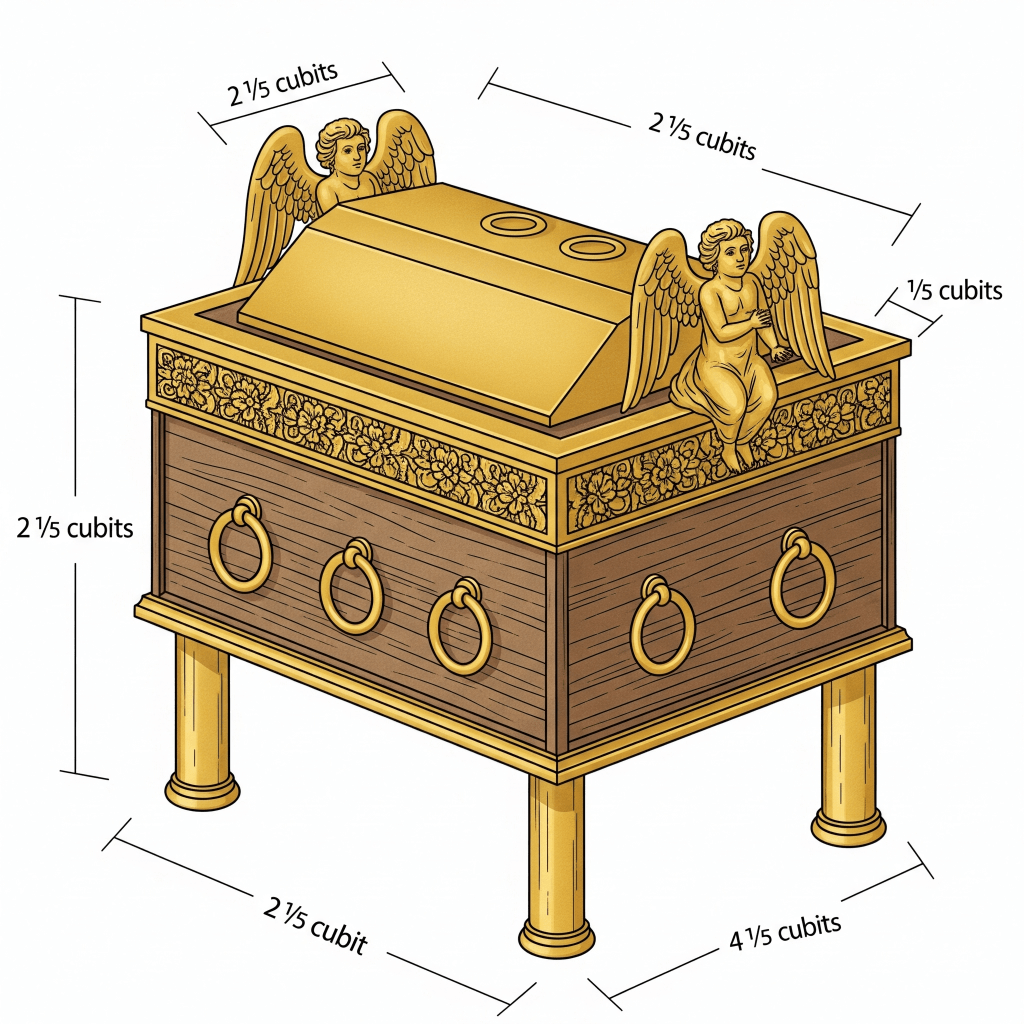
The Ark, mentioned 180 times in the Old Testament, is referred to as the Ark of the Covenant and is considered the throne of God. As Rudy points out in today’s YouTube video, God’s instructions for the Tabernacle begin with its most central element rather than progressing from the outside inward.
The Mercy Seat
In the expression “atonement cover” or “mercy seat,” the underlying term for “atonement” signifies “to ransom” or “deliver” through the means of a sacrifice.
During my time in seminary, I wrote a paper on the theology of Jesus’ blood removing the offense of our sin through his sacrifice.
There’s a Greek word in the Greek translation of the Old Testament that identifies God’s removal of our sins with the “mercy seat.”
This concept highlights that while the Ten Commandments cry out against and condemn our sins, God has graciously provided a place where blood—in Jesus’ case, His blood shed on the cross—covers our sins and brings forgiveness to us.
The Cherubim
Several passages in the Bible indicate that God’s earthly dwelling place was on a throne between the cherubim on the mercy seat above the Ark of the Covenant. The Psalm writer expressed it like this:
Give ear, O Shepherd of Israel,
you who lead Joseph like a flock!
You who are enthroned upon the cherubim, shine forth
Before Ephraim and Benjamin and Manasseh.
Stir up your might,
and come to save us! (Psalm 80:1-2)
The AI image above doesn’t do the cherubim justice, but it does give us an idea of what Moses’ instructions entailed.
You shall make two cherubim of gold; you shall make them of hammered work at the two ends of the cover.
Make one cherub at one end and one cherub at the other; of one piece with the cover you shall make the cherubim at its two ends” (Exodus 25:18-19).
We don’t know much about the cherubim, but one thing is certain: God’s throne is central and remains above all worship and the confusion of daily life. God is always present in his Tabernacle, walking among his people there.
One of the main purposes of worship is to encounter the living God. It is from his throne above the cherubim that he speaks and meets with his people.
Note: I am indebted to Old Testament scholar Walter Kaiser for the information I have presented to you today about this part of the Tabernacle. I’m also indebted to Rudy Ross, who has provided a great explanation in today’s YouTube video.
YouTube Discussion
Rudy Ross gives an excellent description of various items of the tabernacle in today’s YouTube video. He goes beyond what I have written in this article. Bruce Kirby also accompanies me in the video with Rudy.
 Real Voices